Tag: 2026

Around the Parish – February 22, 2026

Slowing Down for What Matters

Each Sunday at Mass, when we pray the Creed, there is a moment where I deliberately slow down.

“I believe in one, holy, catholic, and apostolic Church.”

Some of you may have noticed that I do not rush through those four words. That is intentional.

During Lent, we slow down. We simplify. We return to what is essential. We examine who we are and where we are going. And those four words in the Creed are not decorative. They are essential. They describe the very identity of the Church Christ founded.

And if we forget who we are, we will forget how to live.

For the next four Sundays of Lent, I would like to reflect with you on those four words: one, holy, catholic, apostolic. These are called the four marks of the Church. They are not slogans. They are gifts from Christ. They are promises. And they are responsibilities.

When we say the Church is one, we are professing unity in faith, unity in worship, and unity under Christ. In a world fractured by division, unity is not easy. It requires humility and charity.

When we say the Church is holy, we are not claiming that her members are perfect. We are proclaiming that her Lord is holy and that He continues to sanctify us through the sacraments. Lent reminds us that holiness is not optional.

When we say the Church is catholic, we mean universal. The Church is for every nation, every culture, every generation. The faith does not belong to one time or one group. It is entrusted to all.

When we say the Church is apostolic, we proclaim that she is built upon the foundation of the apostles, handed down faithfully through the centuries. Our faith is not invented. It is received.

These four words are not small. They contain our history, our mission, and our future.

This Lent, I invite you to listen more closely when we reach that line in the Creed. Do not rush through it. Let the words settle. Let them challenge you. Let them remind you who you are.

Because Lent is not simply about giving something up.

It is about becoming who we truly are in Christ.

Thoughts for your week ahead

Remember yesterday and learn from it. Dream about tomorrow and trust God with it. But live for today, because today is the gift you have been given. When we begin to act as though life is a blessing, it starts to feel like one. A true friend strengthens you with prayer, blesses you with love, and encourages you with hope. And what truly differentiates families is not simply how many members they have, but how many are willing to lend a hand in trials rather than stand by as spectators.

Pax et Bonum,
Fr. Andy


The Power and Tradition of Mass Intentions

The Mass is considered the greatest prayer of intercession in the Church. This is because it is the perfect offering of Christ to the Father, making present the Paschal Mystery of His death and resurrection. Traditionally, a Priest may be requested to offer a Mass for a specific intention, even if the requester cannot be physically present.

Offering Masses for the Deceased:

Having a Mass offered for a deceased person is an ancient and commendable practice. A Mass is offered to pray for the departed, that they may find peace in heaven. Since each Mass holds infinite value, requesting one or several Masses is of tremendous benefit to the person prayed for, as well as their family, who can take comfort in knowing that their intention is united with the prayers of the Church.

The Mass: Center of Christian Life:

Every Mass is a precious gift from God. It is the center of the Church’s life, known as “the source and summit of the Christian life,” because in the celebration of the Mass, we are brought back to Jesus’ Last Supper, the first Mass. We consciously recall the love of God poured out for us through the life, death, and resurrection of His only Son, Jesus Christ. At each Mass, all the intentions of God’s people, both living and deceased, are included. As Pope Paul VI noted in his motu proprio “Firma in Traditione,” the faithful, moved by an ecclesial and religious sense, join their own sacrifices to the Eucharistic sacrifice, participating more intensely and supporting the Church’s needs, especially its ministers.

Requesting a Mass Intention:

Anyone may request a Mass Intention for a living person, a deceased person, members of a family, or a special intention appropriate to the celebration of the Eucharist, such as World Peace, Vocations, or Respect for Life. The Church allows only one intention per Mass.

Offering a Mass Stipend:

The normal stipend offering for a Mass is $10. However, a Mass Offering can be more or less than the suggested amount, depending on the financial position of the person requesting the Mass. Envelopes for Mass intention requests are available at the entrances of the church. These envelopes can be placed in the collection basket or returned to the parish office. The requester may also ask for a card to be sent to notify someone that a Mass Intention has been requested (one card per intention). Please note that the name of the person(s) requesting the Mass is not announced.
Around the Parish – February 15, 2026

Standing at the Threshold

This Sunday always feels like we’re standing in a doorway.

Lent is just around the corner. Ash Wednesday is nearly here. We can already sense that familiar shift, from Ordinary Time into a season that asks more of us: more honesty, more intention, more willingness to let God work on us.

And fittingly, the Gospel this weekend places us right at the heart of what Lent is really about.

Jesus tells us that He has not come to abolish the law, but to fulfill it. Then He goes further, much further, than anyone expects. It’s not enough, He says, to simply avoid murder; we must examine anger and resentment. It’s not enough to avoid adultery; we must look honestly at what we desire and how we love. Faith, Jesus makes clear, is not about checking boxes or doing the bare minimum. It’s about the heart.

That’s uncomfortable, and deeply freeing at the same time.

Lent is not meant to be a season of spiritual self-punishment or gloomy obligation. It’s an invitation. An invitation to let God go deeper than our surface-level habits and touch the places where we struggle, where we settle, and where we need healing. Jesus is not raising the bar to make holiness impossible; He’s showing us what a transformed heart actually looks like.

This Sunday gives us a gentle but honest preview of Lent’s purpose. Before we think about ashes, fasting, or giving something up, we’re asked a more fundamental question: Am I willing to let God work on my heart, not just my behavior?

That question can shape how we approach the coming weeks. Maybe Lent this year isn’t about adding more religious tasks, but about creating space: space for prayer that is honest, for reconciliation that is real, for choices that reflect love rather than convenience. Maybe it’s about letting go of grudges, softening hardened attitudes, or paying attention to how we speak to and about others.

Jesus reminds us that holiness isn’t about appearing righteous, it’s about becoming whole.

As we approach Lent, I encourage you not to rush past this moment. Take a breath. Stand in the doorway. Ask the Lord where He wants to work in you this season, not out of guilt or pressure, but out of love.

God desires not just our actions, but our hearts. And that is very good news.

May these final days before Lent help us prepare, not just for a season, but for a deeper encounter with Christ.

Pax et Bonum,
Fr. Andy


The Power and Tradition of Mass Intentions

The Mass is considered the greatest prayer of intercession in the Church. This is because it is the perfect offering of Christ to the Father, making present the Paschal Mystery of His death and resurrection. Traditionally, a Priest may be requested to offer a Mass for a specific intention, even if the requester cannot be physically present.

Offering Masses for the Deceased:

Having a Mass offered for a deceased person is an ancient and commendable practice. A Mass is offered to pray for the departed, that they may find peace in heaven. Since each Mass holds infinite value, requesting one or several Masses is of tremendous benefit to the person prayed for, as well as their family, who can take comfort in knowing that their intention is united with the prayers of the Church.

The Mass: Center of Christian Life:

Every Mass is a precious gift from God. It is the center of the Church’s life, known as “the source and summit of the Christian life,” because in the celebration of the Mass, we are brought back to Jesus’ Last Supper, the first Mass. We consciously recall the love of God poured out for us through the life, death, and resurrection of His only Son, Jesus Christ. At each Mass, all the intentions of God’s people, both living and deceased, are included. As Pope Paul VI noted in his motu proprio “Firma in Traditione,” the faithful, moved by an ecclesial and religious sense, join their own sacrifices to the Eucharistic sacrifice, participating more intensely and supporting the Church’s needs, especially its ministers.

Requesting a Mass Intention:

Anyone may request a Mass Intention for a living person, a deceased person, members of a family, or a special intention appropriate to the celebration of the Eucharist, such as World Peace, Vocations, or Respect for Life. The Church allows only one intention per Mass.

Offering a Mass Stipend:

The normal stipend offering for a Mass is $10. However, a Mass Offering can be more or less than the suggested amount, depending on the financial position of the person requesting the Mass. Envelopes for Mass intention requests are available at the entrances of the church. These envelopes can be placed in the collection basket or returned to the parish office. The requester may also ask for a card to be sent to notify someone that a Mass Intention has been requested (one card per intention). Please note that the name of the person(s) requesting the Mass is not announced.

Around the Parish – February 8, 2026

Lent is Upon Us

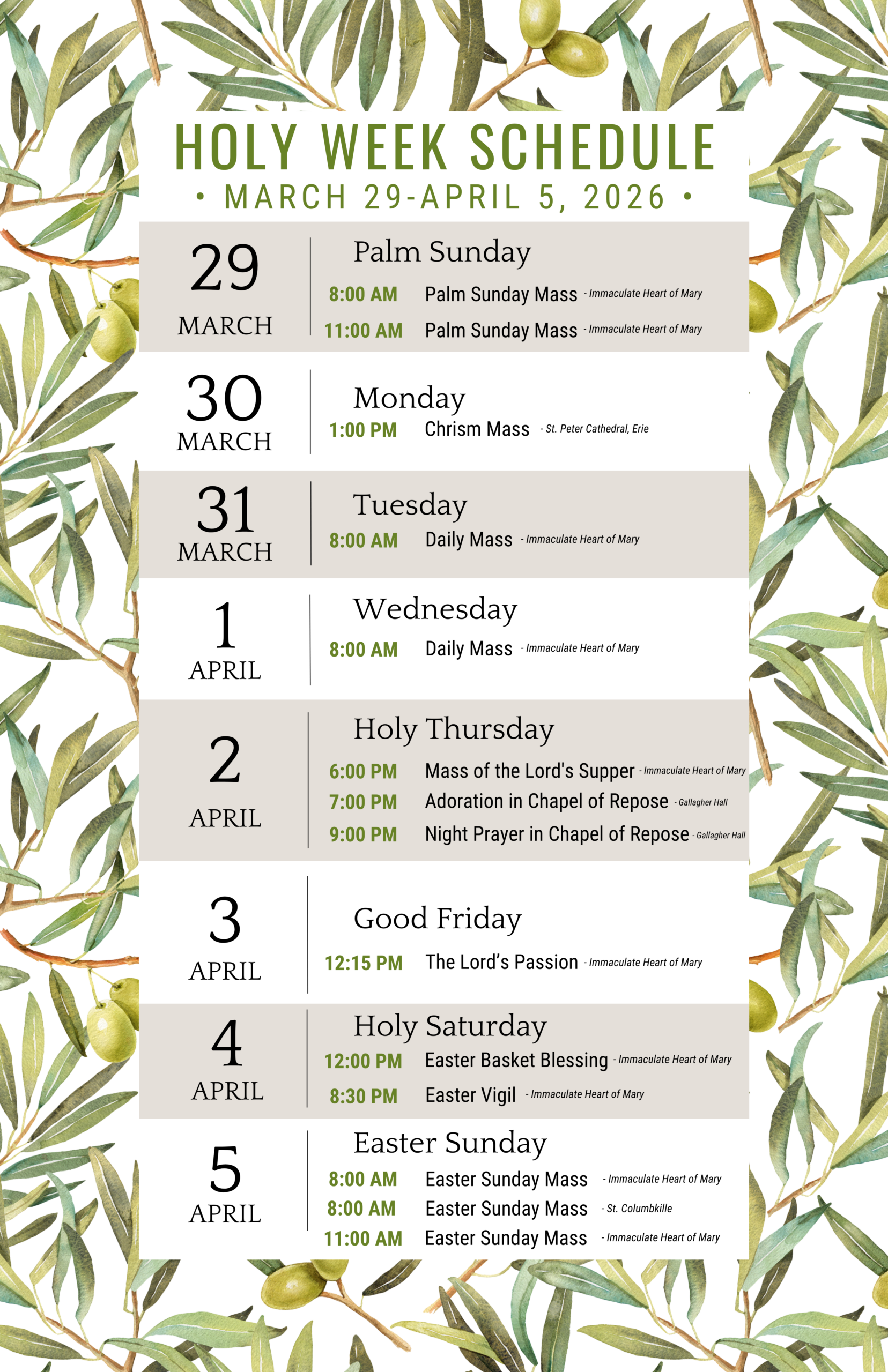
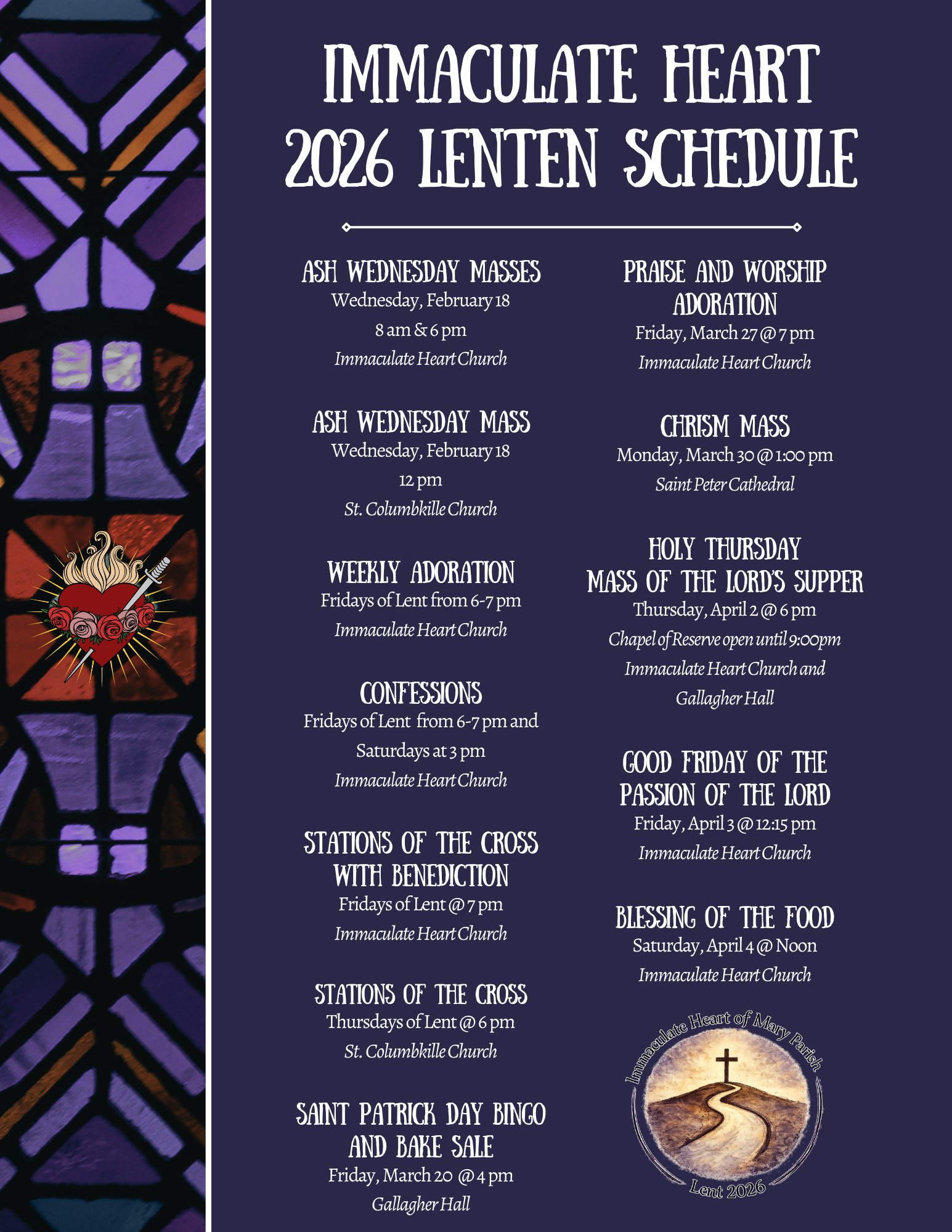
With Ash Wednesday falling on February 18, Lent is fast approaching. Included in this weekend’s bulletin you will find our 2026 Lenten Schedule, outlining many opportunities for prayer, reflection, and spiritual growth. I encourage everyone to take advantage of these offerings as we prepare our hearts for Easter.

Palms for Ash Wednesday

As Ash Wednesday draws near, we invite you to return your palms from last year’s Palm Sunday. Each year these palms are burned to create the ashes that are placed on our foreheads as a sign of repentance and renewal. Containers are located at the doors of the church for your convenience.

Easter Lilly Orders

Also included in this weekend’s bulletin is the Easter Lily order form. These lilies help beautify our church for Easter Sunday and may be given in memory or honor of loved ones. Please return your completed forms to the parish office by the date listed. Thank you for your generosity.

Catholic Services Appeal

This weekend is Commitment Sunday for the Catholic Services Appeal (CSA). Funds raised through the CSA support vital ministries throughout the Diocese of Erie. I ask you to prayerfully consider making a commitment to this important appeal, which helps strengthen the Church far beyond our own parish.

Candlemas Candles

This past Monday we celebrated the Presentation of the Lord, also known as Candlemas, reminding us of Christ as the Light of the World. On this feast day, candles used in our liturgies throughout the year are blessed. Blessed candles are available for purchase near the statue of St. Joseph in church.

St. Patrick Day Bingo & Bake Sale

Please mark your calendars for our annual St. Patrick’s Day Bingo and Bake Sale on Friday, March 20, 2026. Doors open at 5:00 PM, with the first game beginning at 6:00 PM. We are also bringing back our spring bake sale and are gratefully accepting baked goods for this event. Sign-up sheets are available at the church entrances. Baked goods should be returned by Friday, March 20 at 12:00 NOON.

A few thoughts for your week:

Lent begins next week, and now is a great time to do a little planning. A few small decisions made ahead of time can make a big difference.

  • Decide one simple thing you’ll give up and one simple thing you’ll add. (Adding prayer or kindness often matters more than giving up chocolate.)
  • Set a realistic goal—something you can actually keep for forty days.
  • Pick a regular time for prayer, even if it’s just five minutes. Consistency beats perfection.
  • Look for one person you can encourage this week with a call, text, or note.
  • Bring back your old palms and think about what you’d like to leave behind this Lent.

Remember: Lent isn’t about doing everything perfectly. It’s about taking intentional steps toward God and toward one another. Start small. Stay faithful. Let God do the rest.

Pax et Bonum,
Fr. Andy


The Power and Tradition of Mass Intentions

The Mass is considered the greatest prayer of intercession in the Church. This is because it is the perfect offering of Christ to the Father, making present the Paschal Mystery of His death and resurrection. Traditionally, a Priest may be requested to offer a Mass for a specific intention, even if the requester cannot be physically present.

Offering Masses for the Deceased:

Having a Mass offered for a deceased person is an ancient and commendable practice. A Mass is offered to pray for the departed, that they may find peace in heaven. Since each Mass holds infinite value, requesting one or several Masses is of tremendous benefit to the person prayed for, as well as their family, who can take comfort in knowing that their intention is united with the prayers of the Church.

The Mass: Center of Christian Life:

Every Mass is a precious gift from God. It is the center of the Church’s life, known as “the source and summit of the Christian life,” because in the celebration of the Mass, we are brought back to Jesus’ Last Supper, the first Mass. We consciously recall the love of God poured out for us through the life, death, and resurrection of His only Son, Jesus Christ. At each Mass, all the intentions of God’s people, both living and deceased, are included. As Pope Paul VI noted in his motu proprio “Firma in Traditione,” the faithful, moved by an ecclesial and religious sense, join their own sacrifices to the Eucharistic sacrifice, participating more intensely and supporting the Church’s needs, especially its ministers.

Requesting a Mass Intention:

Anyone may request a Mass Intention for a living person, a deceased person, members of a family, or a special intention appropriate to the celebration of the Eucharist, such as World Peace, Vocations, or Respect for Life. The Church allows only one intention per Mass.

Offering a Mass Stipend:

The normal stipend offering for a Mass is $10. However, a Mass Offering can be more or less than the suggested amount, depending on the financial position of the person requesting the Mass. Envelopes for Mass intention requests are available at the entrances of the church. These envelopes can be placed in the collection basket or returned to the parish office. The requester may also ask for a card to be sent to notify someone that a Mass Intention has been requested (one card per intention). Please note that the name of the person(s) requesting the Mass is not announced.

Around the Parish – February 1, 2026

Why Do We Strike Our Breast During the Confiteor?

At the beginning of Mass, we enter into a sacred moment called the Penitential Act. This is when we pause to acknowledge our sins and ask God for mercy, preparing our hearts to worthily celebrate the Eucharist.

One form of the Penitential Act is the Confiteor, which begins:

“I confess to almighty God…”

The word Confiteor comes from Latin and simply means “I confess.” In this prayer, we openly acknowledge before God and one another that we have sinned “in my thoughts and in my words, in what I have done and in what I have failed to do.” It is not meant to shame us, but to free us — to remind us that we come before God not because we are perfect, but because we need His mercy.

During the Confiteor, we say the words:

“through my fault, through my fault, through my most grievous fault,”

and at those words we strike our breast.

This gesture is ancient and deeply biblical. In Scripture, striking the breast is a sign of repentance and humility. In the Gospel, the tax collector “beat his breast” as he prayed, recognizing his sin and trusting in God’s mercy (Luke 18:13). The gesture expresses something words alone cannot: this comes from my heart.

By striking our breast, we are not blaming others or circumstances. We are taking personal responsibility for our sin. It is a physical way of saying, I own this. I need God’s mercy.

Our Catholic faith understands that we worship not only with our minds and voices, but with our bodies. Standing, kneeling, bowing, making the Sign of the Cross, and striking the breast all help us pray with our whole selves. The Confiteor invites us into honesty, humility, and trust — reminding us that every Mass begins with mercy.

And that is good news. Because once we acknowledge our need for God, we are ready to receive everything He longs to give us.

Bring out your Palms

As we prepare for Ash Wednesday and the beginning of Lent, parishioners are invited to bring back last year’s blessed palms to be reverently disposed of and used in the preparation of this year’s ashes. Collection boxes will be located at the entrances of the church. Returning your palms is a meaningful way to take part in the Church’s cycle of prayer, reminding us that what once proclaimed Christ’s triumph now calls us to repentance and renewal of heart.

A few thoughts for your week:

The art of Christian living lies in learning both how to let go and how to hold on. There is an important difference between giving up and letting go. We cannot become who God calls us to be if we remain who we once were. Letting go is not merely about releasing the past; it is about having the wisdom to embrace the future. It is not whether we get knocked down that matters, but whether we rise again. We may be shaped by our past, but we do not have to be prisoners of it.

Pax et Bonum,
Fr. Andy


The Power and Tradition of Mass Intentions

The Mass is considered the greatest prayer of intercession in the Church. This is because it is the perfect offering of Christ to the Father, making present the Paschal Mystery of His death and resurrection. Traditionally, a Priest may be requested to offer a Mass for a specific intention, even if the requester cannot be physically present.

Offering Masses for the Deceased:

Having a Mass offered for a deceased person is an ancient and commendable practice. A Mass is offered to pray for the departed, that they may find peace in heaven. Since each Mass holds infinite value, requesting one or several Masses is of tremendous benefit to the person prayed for, as well as their family, who can take comfort in knowing that their intention is united with the prayers of the Church.

The Mass: Center of Christian Life:

Every Mass is a precious gift from God. It is the center of the Church’s life, known as “the source and summit of the Christian life,” because in the celebration of the Mass, we are brought back to Jesus’ Last Supper, the first Mass. We consciously recall the love of God poured out for us through the life, death, and resurrection of His only Son, Jesus Christ. At each Mass, all the intentions of God’s people, both living and deceased, are included. As Pope Paul VI noted in his motu proprio “Firma in Traditione,” the faithful, moved by an ecclesial and religious sense, join their own sacrifices to the Eucharistic sacrifice, participating more intensely and supporting the Church’s needs, especially its ministers.

Requesting a Mass Intention:

Anyone may request a Mass Intention for a living person, a deceased person, members of a family, or a special intention appropriate to the celebration of the Eucharist, such as World Peace, Vocations, or Respect for Life. The Church allows only one intention per Mass.

Offering a Mass Stipend:

The normal stipend offering for a Mass is $10. However, a Mass Offering can be more or less than the suggested amount, depending on the financial position of the person requesting the Mass. Envelopes for Mass intention requests are available at the entrances of the church. These envelopes can be placed in the collection basket or returned to the parish office. The requester may also ask for a card to be sent to notify someone that a Mass Intention has been requested (one card per intention). Please note that the name of the person(s) requesting the Mass is not announced.

Around the Parish – January 25, 2026

Why We Bow (and Sometimes Genuflect) During the Creed

Someone recently asked me a great question: “Father, why do we bow our heads during the Nicene Creed?” It’s one of those little gestures that many Catholics do automatically, but not everyone knows why we do it. And once you know the meaning, it becomes much more than a habit: it becomes a beautiful moment of prayer.

During the Nicene Creed, we bow our heads at these words:

“and by the Holy Spirit was incarnate of the Virgin Mary, and became man.”

This is not simply a “pause” in the prayer, it is a deliberate sign of reverence. At that moment, the Church is proclaiming one of the most astounding truths of our faith: the Son of God took on human flesh. God did not remain distant. He entered into our world. He took on our human nature through the Blessed Virgin Mary. He became one of us.

So when we bow, we are doing with our bodies what our souls believe:
we honor the mystery of the Incarnation, the humility of Christ who lowered Himself to raise us up.

Twice a Year: We Genuflect

You may also notice something even more striking: twice each year, instead of bowing, we genuflect at the same line of the Creed.

That happens on:

· The Solemnity of the Annunciation (March 25)

· Christmas (Masses of the Nativity of the Lord)

On these days, the Church asks us to make an even deeper gesture because we are celebrating that mystery in a particularly focused way. Christmas celebrates the Word made flesh; the Annunciation celebrates the moment Mary said “yes” and Christ took flesh in her womb. The Creed is the same prayer but the Church invites an even deeper reverence on these feasts.

Faith Isn’t Only Spoken, It’s Lived

Sometimes we think of worship as mostly words: prayers, responses, hymns. But Catholic worship also speaks through gesture: bowing, kneeling, standing, the sign of the cross. These actions are not empty tradition. They are reminders that our faith is not just an idea in our mind, but something we live with our whole self.

That’s especially important today. We live in a noisy world full of distraction. Even at Mass, our minds can wander. But a simple gesture like a bow can serve as a spiritual “anchor,” pulling us back into what we’re saying and what we believe.

A Simple Invitation

So I want to encourage you: try practicing this intentionally. When you reach that line of the Creed, don’t rush through it. Bow deliberately, prayerfully, with gratitude. Let it become your quiet way of saying:

“Lord, I believe You really came for us… and You came for me.”

And when Christmas and the Annunciation come around, we will genuflect together, offering that deeper sign of reverence for the mystery that changed the world forever: God became man.

A few thoughts for your week:

Strength doesn’t come from what you can do. It comes from overcoming what you thought you couldn’t do. There is always light. If only we’re brave enough to see it. If only we’re brave enough to be it. If you want to make an easy job seem mighty hard, just keep putting off doing it. Someday is not a day of the week.

Pax et Bonum,
Fr. Andy


The Power and Tradition of Mass Intentions

The Mass is considered the greatest prayer of intercession in the Church. This is because it is the perfect offering of Christ to the Father, making present the Paschal Mystery of His death and resurrection. Traditionally, a Priest may be requested to offer a Mass for a specific intention, even if the requester cannot be physically present.

Offering Masses for the Deceased:

Having a Mass offered for a deceased person is an ancient and commendable practice. A Mass is offered to pray for the departed, that they may find peace in heaven. Since each Mass holds infinite value, requesting one or several Masses is of tremendous benefit to the person prayed for, as well as their family, who can take comfort in knowing that their intention is united with the prayers of the Church.

The Mass: Center of Christian Life:

Every Mass is a precious gift from God. It is the center of the Church’s life, known as “the source and summit of the Christian life,” because in the celebration of the Mass, we are brought back to Jesus’ Last Supper, the first Mass. We consciously recall the love of God poured out for us through the life, death, and resurrection of His only Son, Jesus Christ. At each Mass, all the intentions of God’s people, both living and deceased, are included. As Pope Paul VI noted in his motu proprio “Firma in Traditione,” the faithful, moved by an ecclesial and religious sense, join their own sacrifices to the Eucharistic sacrifice, participating more intensely and supporting the Church’s needs, especially its ministers.

Requesting a Mass Intention:

Anyone may request a Mass Intention for a living person, a deceased person, members of a family, or a special intention appropriate to the celebration of the Eucharist, such as World Peace, Vocations, or Respect for Life. The Church allows only one intention per Mass.

Offering a Mass Stipend:

The normal stipend offering for a Mass is $10. However, a Mass Offering can be more or less than the suggested amount, depending on the financial position of the person requesting the Mass. Envelopes for Mass intention requests are available at the entrances of the church. These envelopes can be placed in the collection basket or returned to the parish office. The requester may also ask for a card to be sent to notify someone that a Mass Intention has been requested (one card per intention). Please note that the name of the person(s) requesting the Mass is not announced.

Around the Parish – January 18, 2026

Continued Maintenance

On December 30, 2025, we discovered a water leak in the rectory originating near the boiler room, caused by plumbing from the bathrooms on the upper floors. Once the leak was identified, the water was shut off immediately to prevent further damage. Unfortunately, the issue had already affected more than just the plumbing, it also impacted the boiler itself.

Because of the cold temperatures at the time, the boiler was temporarily restored so that heat could remain on in the building. However, we were advised that replacement would be the best long-term solution, since parts for this particular boiler system are becoming increasingly difficult to find.

After notifying our insurance company, we were instructed to bring in a professional remediation team due to concerns about possible mold. When the plumber opened the wall in the first-floor bathrooms, significant black mold was discovered inside. The remediation company promptly removed the affected wall sections, which included portions of two bathrooms on the first floor of the rectory.

While this situation was certainly unexpected, it is a blessing that it was discovered when it was, and that it can now be properly addressed. We have been informed that insurance will cover the full scope of necessary repairs, including a new boiler and complete restoration of the first-floor bathrooms. Although this project came as a surprise, it is an important and necessary step to ensure the rectory remains safe, healthy, and structurally sound moving forward. Our buildings have served the parish faithfully for many years, and as they now approach 75 years in age, occasional repairs and unexpected projects are sometimes part of responsible stewardship as we care for the spaces that support our parish life and mission. We are grateful that the cost of this repair is being covered, and we appreciate everyone’s patience and prayers as this work progresses.

A few thoughts for your week:

This weekend’s readings remind us that a good life is built on small, steady choices. It’s easy to think we need a dramatic plan or a major change to become better people, but Scripture points us to something simpler: showing up, being faithful, and doing what’s right in front of us. “Here I am, Lord,” can also mean: I’m present today, I’m going to do the next right thing, and I’m going to try again even if yesterday didn’t go well. In the Gospel, John the Baptist doesn’t make life about himself, he points to Jesus. That’s a great challenge for the week: in conversation, at work, and at home, can we become the kind of person who brings peace instead of tension, encouragement instead of criticism, and hope instead of negativity? Holiness often looks like ordinary maturity: staying calm, listening well, keeping your word, being patient, and treating people with kindness, even when you’re tired.

Pax et Bonum,
Fr. Andy


The Power and Tradition of Mass Intentions

The Mass is considered the greatest prayer of intercession in the Church. This is because it is the perfect offering of Christ to the Father, making present the Paschal Mystery of His death and resurrection. Traditionally, a Priest may be requested to offer a Mass for a specific intention, even if the requester cannot be physically present.

Offering Masses for the Deceased:

Having a Mass offered for a deceased person is an ancient and commendable practice. A Mass is offered to pray for the departed, that they may find peace in heaven. Since each Mass holds infinite value, requesting one or several Masses is of tremendous benefit to the person prayed for, as well as their family, who can take comfort in knowing that their intention is united with the prayers of the Church.

The Mass: Center of Christian Life:

Every Mass is a precious gift from God. It is the center of the Church’s life, known as “the source and summit of the Christian life,” because in the celebration of the Mass, we are brought back to Jesus’ Last Supper, the first Mass. We consciously recall the love of God poured out for us through the life, death, and resurrection of His only Son, Jesus Christ. At each Mass, all the intentions of God’s people, both living and deceased, are included. As Pope Paul VI noted in his motu proprio “Firma in Traditione,” the faithful, moved by an ecclesial and religious sense, join their own sacrifices to the Eucharistic sacrifice, participating more intensely and supporting the Church’s needs, especially its ministers.

Requesting a Mass Intention:

Anyone may request a Mass Intention for a living person, a deceased person, members of a family, or a special intention appropriate to the celebration of the Eucharist, such as World Peace, Vocations, or Respect for Life. The Church allows only one intention per Mass.

Offering a Mass Stipend:

The normal stipend offering for a Mass is $10. However, a Mass Offering can be more or less than the suggested amount, depending on the financial position of the person requesting the Mass. Envelopes for Mass intention requests are available at the entrances of the church. These envelopes can be placed in the collection basket or returned to the parish office. The requester may also ask for a card to be sent to notify someone that a Mass Intention has been requested (one card per intention). Please note that the name of the person(s) requesting the Mass is not announced.

Around the Parish – January 11, 2026

The Baptism of the Lord

The Feast of the Baptism of the Lord brings the Christmas season to a quiet but powerful close. After the light of the manger and the glory of the star, we find Jesus standing in the waters of the Jordan—shoulder to shoulder with sinners, waiting in line with those seeking repentance. It is a striking and almost unsettling image. The sinless Son of God does not remain apart. He steps directly into the mess of human life.

Jesus does not need baptism, yet He chooses it. In doing so, He reveals something essential about who He is and how God works. Christ does not save us from a distance. He enters fully into our reality. In the Jordan River, He sanctifies the waters—and through them, all of creation—by His presence. From that moment on, water will never be just water again. It becomes a place of encounter, cleansing, and new birth.

As Jesus rises from the water, the heavens open, the Spirit descends, and the Father’s voice is heard: “You are my beloved Son; with you I am well pleased.” This moment is not only a revelation of who Jesus is, but also a glimpse of who we are called to be. At our own baptism, those same heavens were opened for us. The same Spirit was given to us. And the same Father claimed us as His beloved sons and daughters.

The Baptism of the Lord reminds us that baptism is not merely a past event or a box checked long ago. It is an identity we live every day. To be baptized is to belong to Christ, to be marked by His love, and to be sent into the world as His presence. Baptism commissions us to live differently—to reject sin, to choose light over darkness, and to love as Christ loves.

As we move into Ordinary Time, this feast invites us to remember the extraordinary gift we carry. We are not alone. We are not abandoned. We are baptized—claimed by God, filled with the Spirit, and called to walk as children of light. The same Lord who stood in the Jordan stands with us still, reminding us who we are and whose we are.

A few thoughts for your week:

As a new week begins, it can be helpful to focus on what is right in front of us rather than everything at once. Break larger tasks into smaller steps, take one day at a time, and give yourself permission to slow down when needed. Consistency matters more than perfection, and steady effort often brings more peace than rushing from one obligation to the next.

This week, be mindful of how you treat both others and yourself. A kind word, a moment of patience, or choosing to listen rather than react can make a real difference in daily interactions. At the same time, remember that rest is not wasted time. Making space for balance—between work, responsibilities, and rest—helps us show up more present, focused, and generous in all that we do.

Pax et Bonum,
Fr. Andy


The Power and Tradition of Mass Intentions

The Mass is considered the greatest prayer of intercession in the Church. This is because it is the perfect offering of Christ to the Father, making present the Paschal Mystery of His death and resurrection. Traditionally, a Priest may be requested to offer a Mass for a specific intention, even if the requester cannot be physically present.

Offering Masses for the Deceased:

Having a Mass offered for a deceased person is an ancient and commendable practice. A Mass is offered to pray for the departed, that they may find peace in heaven. Since each Mass holds infinite value, requesting one or several Masses is of tremendous benefit to the person prayed for, as well as their family, who can take comfort in knowing that their intention is united with the prayers of the Church.

The Mass: Center of Christian Life:

Every Mass is a precious gift from God. It is the center of the Church’s life, known as “the source and summit of the Christian life,” because in the celebration of the Mass, we are brought back to Jesus’ Last Supper, the first Mass. We consciously recall the love of God poured out for us through the life, death, and resurrection of His only Son, Jesus Christ. At each Mass, all the intentions of God’s people, both living and deceased, are included. As Pope Paul VI noted in his motu proprio “Firma in Traditione,” the faithful, moved by an ecclesial and religious sense, join their own sacrifices to the Eucharistic sacrifice, participating more intensely and supporting the Church’s needs, especially its ministers.

Requesting a Mass Intention:

Anyone may request a Mass Intention for a living person, a deceased person, members of a family, or a special intention appropriate to the celebration of the Eucharist, such as World Peace, Vocations, or Respect for Life. The Church allows only one intention per Mass.

Offering a Mass Stipend:

The normal stipend offering for a Mass is $10. However, a Mass Offering can be more or less than the suggested amount, depending on the financial position of the person requesting the Mass. Envelopes for Mass intention requests are available at the entrances of the church. These envelopes can be placed in the collection basket or returned to the parish office. The requester may also ask for a card to be sent to notify someone that a Mass Intention has been requested (one card per intention). Please note that the name of the person(s) requesting the Mass is not announced.

Around the Parish – January 4, 2026

The Epiphany of the Lord

Today we celebrate the Epiphany of the Lord—the great moment when Christ is revealed not only to Israel, but to the whole world. In the visit of the Magi, we see seekers who follow the light they are given and are led to Christ Himself. Epiphany reminds us that Jesus is not meant to be hidden or kept to ourselves; He is a gift to be shared. As we begin this new year, may we, like the Magi, be attentive to God’s guidance, generous in our response, and willing to offer our lives as gifts to the Lord who has first revealed Himself to us.

And They’ll Know We are Christians by Our LOVE

This weekend marks the first combined bulletin for Immaculate Heart of Mary and St. Columbkille. While times of change can feel uncertain, this is also a moment filled with promise and possibility. Together, our two parish communities bring a richness of faith, history, and generosity that can strengthen our witness to the Gospel. Thank you for your patience, your openness, and your understanding as we begin this new chapter. We are not simply merging schedules or announcements; we are coming together as one family of believers, united in Christ and called to walk forward in hope.

Mass Schedule Changes

I am deeply grateful for your continued understanding and flexibility as the new Mass schedule takes effect at both Immaculate Heart and St. Columbkille. Adjusting routines is never easy, but these changes are made with prayer, care, and a desire to serve our shared parish family well. As we grow together, let us remember that the family that prays together truly does stay together. Thank you for your generosity of spirit and your commitment to worship, community, and one another as we move forward together in faith.

A few thoughts for your week:

As you enter this week, let the spirit of the Epiphany shape your outlook. God is still revealing Himself, often quietly, often unexpectedly, to those who are willing to look for His light. Pay attention to the moments that draw your heart toward hope, generosity, and trust; they may be gentle invitations from the Lord guiding your next steps.

Like the Magi, do not be afraid to move forward even when the road feels unfamiliar. Faith often requires us to step out without seeing the whole picture, trusting that God is already at work ahead of us. This week, allow yourself to believe that something good is unfolding, even if it is not yet fully clear.

Finally, remember that every encounter, every conversation, every small act of kindness, can become an epiphany, a moment where Christ is made known through you. Walk into this week with confidence and expectation, trusting that God has great things in store and that His light will continue to guide you forward.

Pax et Bonum,
Fr. Andy


The Power and Tradition of Mass Intentions

The Mass is considered the greatest prayer of intercession in the Church. This is because it is the perfect offering of Christ to the Father, making present the Paschal Mystery of His death and resurrection. Traditionally, a Priest may be requested to offer a Mass for a specific intention, even if the requester cannot be physically present.

Offering Masses for the Deceased:

Having a Mass offered for a deceased person is an ancient and commendable practice. A Mass is offered to pray for the departed, that they may find peace in heaven. Since each Mass holds infinite value, requesting one or several Masses is of tremendous benefit to the person prayed for, as well as their family, who can take comfort in knowing that their intention is united with the prayers of the Church.

The Mass: Center of Christian Life:

Every Mass is a precious gift from God. It is the center of the Church’s life, known as “the source and summit of the Christian life,” because in the celebration of the Mass, we are brought back to Jesus’ Last Supper, the first Mass. We consciously recall the love of God poured out for us through the life, death, and resurrection of His only Son, Jesus Christ. At each Mass, all the intentions of God’s people, both living and deceased, are included. As Pope Paul VI noted in his motu proprio “Firma in Traditione,” the faithful, moved by an ecclesial and religious sense, join their own sacrifices to the Eucharistic sacrifice, participating more intensely and supporting the Church’s needs, especially its ministers.

Requesting a Mass Intention:

Anyone may request a Mass Intention for a living person, a deceased person, members of a family, or a special intention appropriate to the celebration of the Eucharist, such as World Peace, Vocations, or Respect for Life. The Church allows only one intention per Mass.

Offering a Mass Stipend:

The normal stipend offering for a Mass is $10. However, a Mass Offering can be more or less than the suggested amount, depending on the financial position of the person requesting the Mass. Envelopes for Mass intention requests are available at the entrances of the church. These envelopes can be placed in the collection basket or returned to the parish office. The requester may also ask for a card to be sent to notify someone that a Mass Intention has been requested (one card per intention). Please note that the name of the person(s) requesting the Mass is not announced.

A Letter to the Parishioners of St. Columbkille Parish in Stoneboro, PA

December 19, 2025

This letter is addressed to the parishioners of St. Columbkille Parish, Stoneboro, and is to be read to the parishioners at all Masses December 20-21, 2025

Brothers and Sisters in Christ:

As you know, Father Robert Manning retired for medical reasons, effective November 30.  He served the parish generously and kindly for many years and I wrote to him expressing my gratitude. I have appointed Father Andrew Boyd as Pastor of St. Columbkille, effective December 16.  Father Boyd will continue as Pastor of Immaculate Heart of Mary Parish, Mercer, and as the Dean of the Greenville Deanery. 

Because of Father Boyd’s multiple duties, as well as the demands on our retired priests, we need to adjust the Mass schedules for both St. Columbkille Parish and Immaculate Heart of Mary Parish.  The new schedule for the parishes will be:

  • St. Columbkille will have an anticipated Mass on Saturdays at 6:00pm.  We are not able to provide a priest for Sunday morning Mass in the current circumstances.
  • Immaculate Heart of Mary Parish will adjust its schedule so that Father Boyd is able to fulfill his new duties.  The Masses at IHM will be on Saturday at 4:00pm, and on Sunday at 8:00am, and 11:00am.

This Mass schedule will become effective Saturday, January 3, 2026, and is for a six-month trial period, at which time it will be reviewed.

I am aware that this adjustment may cause some inconvenience at first, but I ask you to support Father Boyd and continue to pray for an increase of vocations.

Sincerely yours in Christ,

+Lawrence T. Persico

The Most Reverend Lawrence T. Persico, JCL

Bishop of Erie